
//Affiliate Disclaimer: This post may contain affiliate links which mean I may receive a commission for purchases made through links. I will only recommend products that I personally love! Learn more on my Privacy Page.
Pharmacology has a reputation for being one of the hardest subjects in pharmacy school, and honestly, that reputation is earned. There are thousands of drugs, dozens of drug classes, and an overwhelming number of mechanisms, side effects, and interactions to keep straight. Cramming doesn’t work here. If you’ve tried to memorize your way through a pharm exam, you already know how quickly that information disappears the second you walk out of the testing room.
The good news: pharmacology becomes dramatically easier once you stop trying to memorize facts and start understanding systems. Below is a step-by-step method that combines repetition, active recall, and teaching — the three ingredients that actually build long-term retention.
Step 1: Start With Mechanisms, Not Drug Names
The biggest mistake students make is memorizing drug names before understanding what the drug actually does at a receptor or enzyme level. Instead, flip the order.
Start by learning the receptors, enzymes, and physiological pathways involved in a body system. Ask yourself:
– What does this receptor do when it’s activated?
– What happens when it’s blocked?
– What downstream effects follow from that activation or blockage?
Once you understand a receptor’s normal function, drugs stop being random names to memorize and start becoming logical extensions of what you already know. For example, once you understand that beta-1 receptors increase heart rate and contractility, a beta-blocker’s effects — and its side effects — become predictable rather than something you have to memorize from a list.
This “mechanism-first” approach is the single highest-leverage habit you can build in pharmacology. Everything else in this guide builds on it.
Step 2: Group Drugs by Class, Then Learn the Exceptions
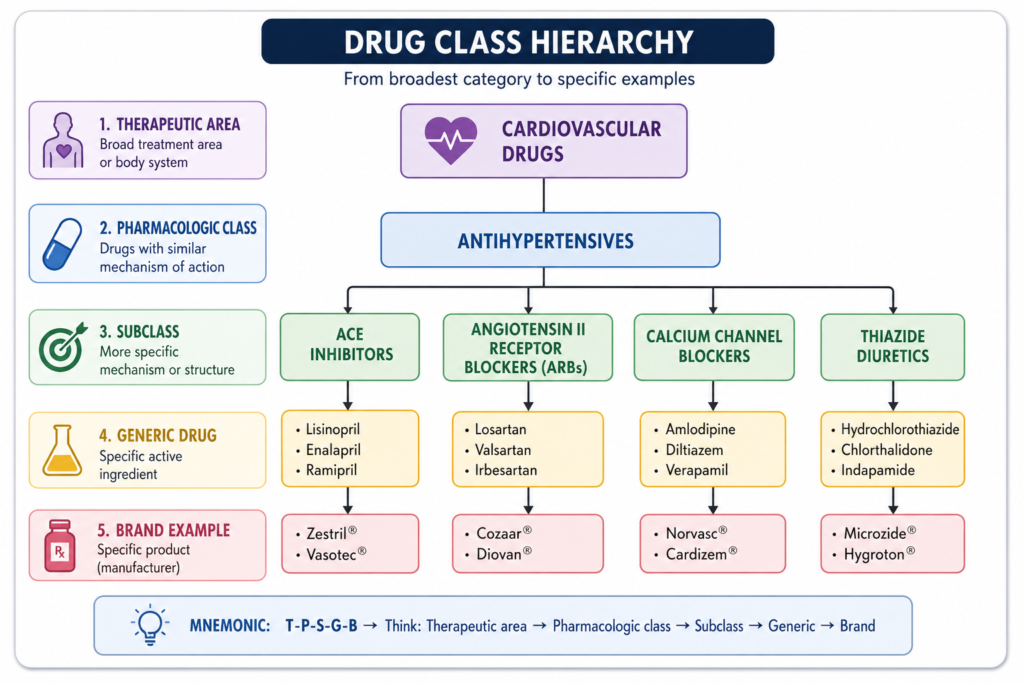
After you understand the mechanism behind a receptor or pathway, group the drugs that act on it into a class. Learn the class as a unit first — mechanism, primary effects, common side effects, contraindications — and only then move to individual drugs within that class.
Most drugs in a class behave the same way. Your job is to learn the “rule” for the class, then memorize only the exceptions. This cuts your workload dramatically because you’re no longer treating every drug as a brand-new fact to learn from scratch.
A simple framework:
1. What is the class mechanism?
2. What are the class-wide effects and side effects?
3. Which drug(s) in this class break the pattern, and how?
Step 3: Use Spaced Repetition, Not One-Time Review
Understanding a mechanism once is not the same as retaining it. This is where repetition comes in — specifically, spaced repetition, where you review material at increasing intervals over time instead of cramming it all in one sitting.
A practical schedule looks like this:
– Day 1: Learn the material for the first time (mechanism-first, as above).
– Day 2: Quick review — no new material, just recall what you learned.
– Day 4–5: Review again, this time testing yourself without looking at notes.
– Day 10: One more review pass.
– Weekly after that: A fast recall check to keep it fresh until the exam.
Flashcard apps that use spaced repetition algorithms can automate this scheduling for you, which is especially useful when you’re juggling multiple systems (cardiovascular, CNS, renal, etc.) at the same time. The key is consistency — repetition spread out over days does far more for long-term memory than the same amount of time spent studying in one sitting.
Step 4: Test Yourself Before You Feel Ready
Passive review — rereading notes, highlighting, re-watching lecture slides — feels productive but does very little for retention. Active recall, where you force your brain to retrieve information without looking at the answer, is what actually builds durable memory.
Practical ways to build active recall into your routine:
– Close your notes and write out everything you remember about a drug class from memory, then check for gaps.
– Use practice questions instead of just reading content, even before you feel “ready.”
– Create your own quiz questions as you study — writing a good question forces you to understand the material at a deeper level than answering one does.

Step 5: Teach It to Someone Else (The Real Mastery Test)
This is the step most students skip, and it’s the one that matters most. If you can’t explain a drug class to someone else — in plain language, without your notes — you don’t actually understand it yet. You’ve just recognized it.
Teaching forces you to:
– Organize information into a logical sequence
– Identify the parts you don’t actually understand (which usually only becomes obvious when you try to explain them out loud)
– Simplify complex mechanisms into language a non-expert could follow
You don’t need a real student to teach. Explain a drug class out loud to a study partner, a rubber duck, an empty room, or even record yourself and play it back. If you find yourself fumbling, going quiet, or resorting to jargon you can’t define, that’s your sign to go back and re-study that specific gap — not the whole topic, just the piece where you got stuck.
This single habit, done consistently after each study session, will save you more time before exams than almost anything else on this list, because it tells you exactly what to review instead of forcing you to re-read everything “just in case.”
Step 6: Connect New Drugs to What You Already Know
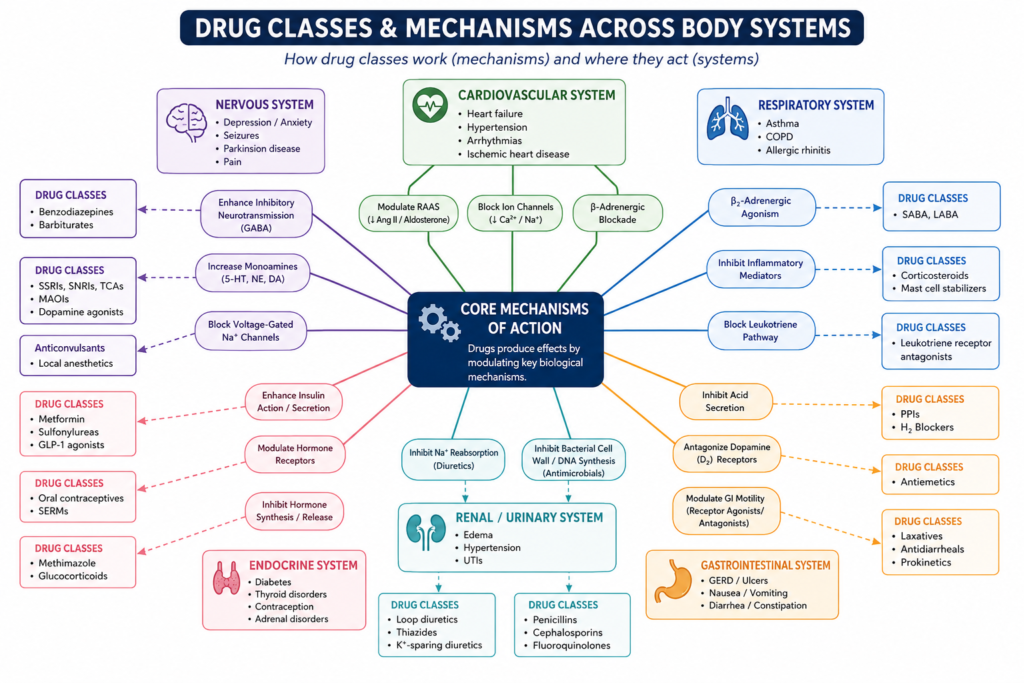
As you move through different body systems, actively look for overlaps. Many drug classes share mechanisms across systems — for example, understanding how anticholinergic effects work in one context (like an antihistamine) makes it much easier to predict the side effects of an unrelated drug that also has anticholinergic activity.
Every time you learn a new drug, ask:
– Does this remind me of a mechanism I already know?
– What side effects would I predict, based on that mechanism, before I even look them up?
This habit turns pharmacology from a subject with thousands of disconnected facts into a much smaller set of patterns that repeat across systems.
Step 7: Build a Weekly Review Rotation
Once you have more than one or two systems under your belt, it’s easy to let earlier material fade while you focus on what’s new. Prevent this by building a rotating review schedule:
– New material: Most of your study time.
– Recent material (last 1–2 weeks): A shorter daily or every-other-day review.
– Older material: A brief weekly check-in, just enough to keep it retrievable.
This is really an extension of Step 3, but applied across your entire course rather than a single topic. The goal is that by the time your exam covers everything from the semester, no single system feels “forgotten.”
Step 8: Simulate Exam Conditions Before the Real Thing
In the final days before an exam, shift from studying content to practicing retrieval under exam-like conditions:
– Timed practice tests, ideally with the same number of questions and time limit as your actual exam
– No notes, no interruptions
– Review every wrong answer by going back to the mechanism, not just memorizing the correct choice
If a question stumps you, don’t just note the right answer — trace it back to the underlying mechanism you learned in Step 1. This closes the loop and reinforces the understanding-based approach instead of letting exam prep slide back into memorization.

Putting It All Together
Here’s what a realistic weekly rhythm looks like when you combine all of these steps:
1. Learn new material mechanism-first (Step 1–2)
2. Do a same-day active recall check (Step 4)
3. Teach the material to someone else within 24–48 hours (Step 5)
4. Schedule spaced review sessions over the following two weeks (Step 3)
5. Rotate in older material weekly so nothing goes stale (Step 7)
6. In exam week, switch to timed practice tests and mechanism-based review of mistakes (Step 8)
None of these steps are complicated on their own. What makes this approach effective is doing them consistently, together, rather than relying on any single technique in isolation. Pharmacology rewards students who understand *why* a drug does what it does — once that clicks, the sheer volume of material stops feeling impossible and starts feeling like a pattern you already know how to read.
—
Have a study method that’s worked for you in pharm school? I’d love to hear about it — drop it in the comments below.