
This post contains affiliate links. If you purchase through one of these links, I may earn a small commission at no extra cost to you. I only recommend resources I’ve used myself or would genuinely tell a student to buy. Views are my own and not those of any employe
If you’ve typed “how to study for the NAPLEX” into Google at 1 a.m., stressed and half-convinced you’ve forgotten everything you learned — I’ve been there. The NAPLEX isn’t just another exam. It’s the gate between four (or six) years of training and actually being able to call yourself a pharmacist. Put simply, it’s the test between you being called a doctor, and you being called a doctor who can actually practice. That pressure is real, and it makes the “which resource should I actually buy” question feel a lot higher-stakes than it needs to be.
The good news: you don’t need every resource on the market. You need the right few, used the right way, on a schedule that doesn’t burn you out before test day. I’ve sat on the other side of this exam for years, precepted prepping students, and talked to residents and new grads. This is the resource list I actually give people — not a sponsored “top 10” list padded with products nobody uses.

What Actually Matters When Choosing NAPLEX Study Resources
Before we get into specific products, let’s talk about what separates a resource that works from one that sits on your shelf.
A good NAPLEX resource should:
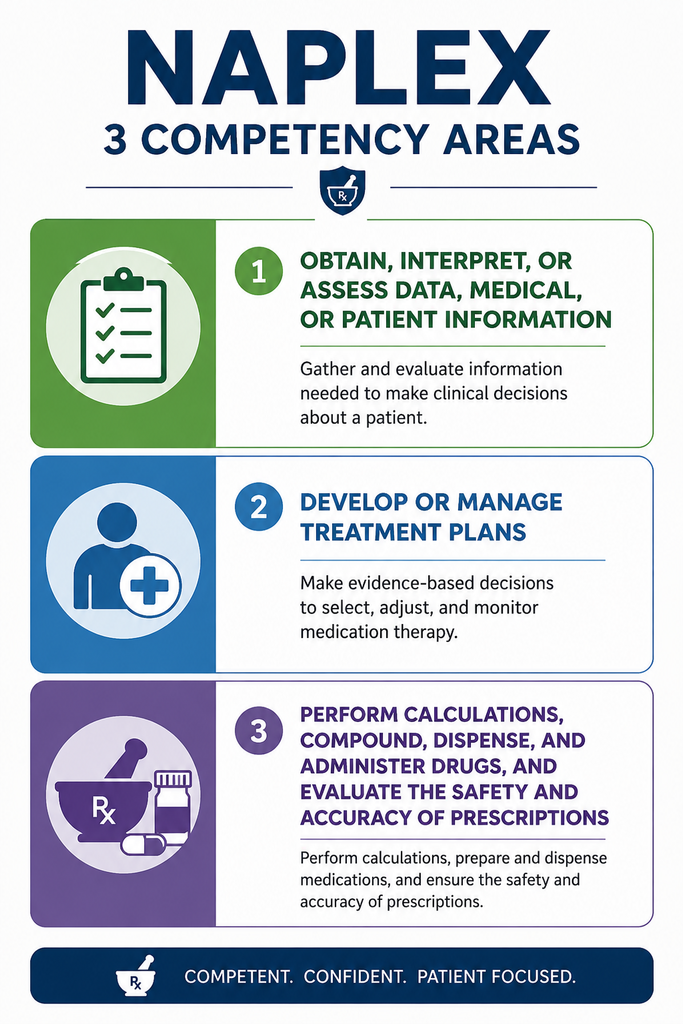
- Mirror the NAPLEX blueprint. The exam tests three main competency areas — obtaining, interpreting, and evaluating patient information. Identifying medication therapy problems and developing care plans; and preparing, dispensing, and administering medications. Your resources should map to this, not just rehash P1-year content.
- Include practice questions with rationales, not just answer keys. You learn far more from understanding why a distractor is wrong than from getting a question right on a lucky guess.
- Fit your actual schedule. The best resource is the one you’ll consistently use, not the one that looks comprehensive but sits unopened.
- Be current. Guidelines change. A review book from five years ago may still have outdated dosing or old first-line therapies baked into its practice questions.
With that filter in mind, here’s what I’d actually put in your NAPLEX prep toolkit.
Before Any Resources: Set Aside Dedicated Study Time
I want to say this before we get into any specific product, because it matters more than every resource on this list combined. Without a dedicated, protected study schedule, no resource in the world will make a difference. It doesn’t matter how good the review book is or how well-written the question bank rationales. If you’re only opening them sporadically, whenever you happen to feel motivated.
Block out actual, non-negotiable study time on your calendar the same way you would a rotation shift or a class. Treat it as an appointment you can’t skip, not something you’ll get to “if there’s time.” The resources below are only as good as the consistency you bring to them. The perfect toolkit and use it inconsistently, and you’ll still walk into test day underprepared.
1. A Strong Core Review Book
Every solid NAPLEX prep plan starts with one comprehensive review resource — not five. Trying to work through multiple overlapping review books at once is one of the most common mistakes I see students make; it splits your attention without actually deepening your knowledge.
Look for a review book that organizes content by disease state and includes high-yield tables for things like renal dosing adjustments, black box warnings, and drug interactions. RxPrep (which currently does not have a 2026-2027 edition available) and the APhA Complete Review for Pharmacy are two of the most commonly used standalone options among students I’ve talked to, and both are easy to find through Amazon if you want to compare current editions and reviews before buying. If you’d rather have your content review and practice questions built into a single platform, UWorld Rx Prep bundles both together, which can simplify things if you don’t want to juggle a separate book and question bank; the book alone, UWorld RxPrep 2027 NAPLEX Course Book, is also available on Amazon. Whichever route you choose, check that you’re getting the most recent edition or an active subscription — guideline updates move fast enough that outdated material can actually work against you.
Whatever core book you choose, plan to go through it twice: once for initial content review, and once closer to your test date as a targeted refresher on your weak areas.

2. A Question Bank With Real Rationales
If your review book is where you learn content, your question bank is where you find out what you actually know versus what you think you know. This gap is bigger than most students expect. I’ve watched confident students bomb their first full-length practice exam simply because reading content and retrieving it under pressure are two completely different skills.
A good question bank should:
- Let you filter by topic so you can drill weak areas specifically
- Include full explanations for both correct and incorrect answers
- Offer at least one full-length timed practice exam that mimics the real testing conditions
This is the category where I most often point students toward UWorld Rx Prep. Their question bank is built specifically around the NAPLEX blueprint, the rationales go into real depth on both the correct answer and why each distractor is wrong, and their performance analytics make it easy to see exactly which topics you need to circle back to — which matters more than people expect, since “I feel weak in cardiology” and “my data shows I’m missing anticoagulation dosing specifically” lead to very different review sessions.
Aim to start question banks about three to four weeks before your test date. Early enough to catch and correct knowledge gaps, but late enough that the content is still fresh heading into exam day.

3. Calculations Practice (Don’t Skip This)
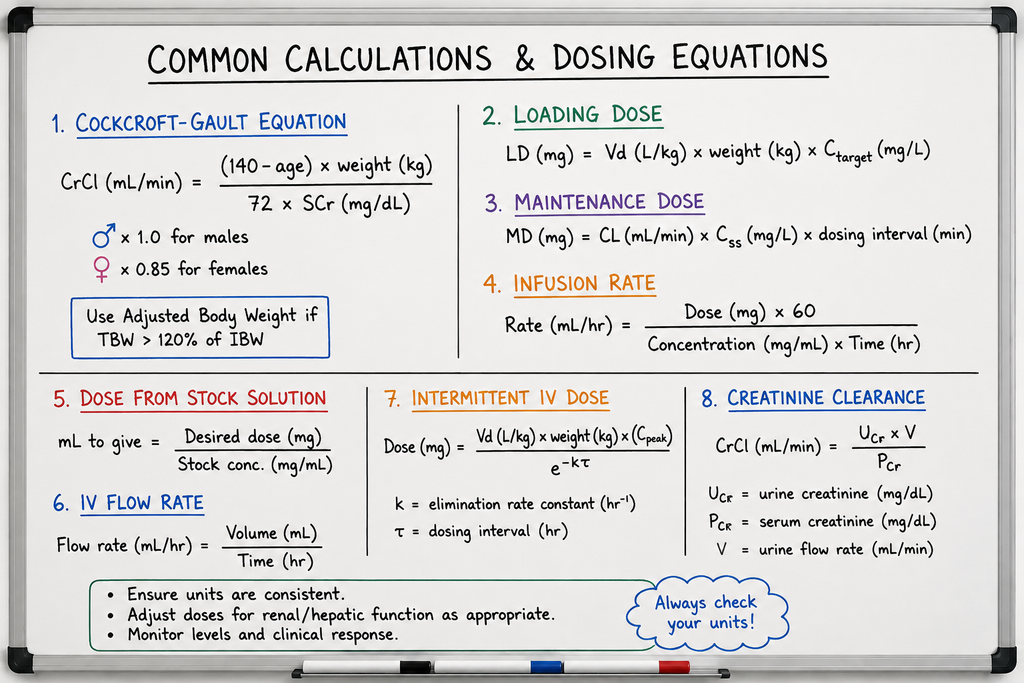
Pharmacy calculations questions have a reputation for being the silent killer of NAPLEX scores — not because the math is inherently hard, but because it’s easy to get rusty on unit conversions, IV flow rates, and pediatric dosing if you haven’t touched them since a calculations course two years ago.
Set aside dedicated calculations time separate from your general content review. I recommend doing at least 15-20 calculation problems a day for three weeks leading up to your exam, targeting:
- IV drip rates and flow calculations
- Pediatric and renal dose adjustments
- Compounding and dilution problems
- Pharmacokinetic calculations (loading dose, maintenance dose, half-life)
4. A Study Planner or Digital Task System
This one surprises people, but the students I see burn out or run out of time before their exam almost always have one thing in common: no structured plan. NAPLEX prep typically spans six to ten weeks, and without a system to track what you’ve covered, it’s incredibly easy to spend three weeks on cardiology because it feels comfortable and cram infectious disease into the final 48 hours.
I’m a big believer in using an actual task management system for this rather than a mental checklist. Todoist works well for this . You can build out a week-by-week study plan with recurring daily tasks (calculations, flashcard review, one disease-state chapter), check things off as you go, and actually see your progress instead of just feeling vaguely anxious about how much is left.
If you prefer analog planning, a dedicated study planner with weekly and daily layouts works just as well. The important part is externalizing the plan so your brain isn’t trying to hold the whole schedule in working memory on top of the content itself.

5. Flashcards for High-Yield Memorization
Some content just has to be memorized — black box warnings, pregnancy categories, controlled substance schedules, vaccine schedules. Flashcards (physical or app-based) are still one of the most efficient tools for this kind of rote recall.
Build your own deck as you go through your review book rather than relying entirely on a pre-made set. The act of writing the card is itself a form of active recall, and a pre-made deck someone else built will never be perfectly matched to your specific weak spots.
Don’t Skip the “Strange” Topics
When students picture NAPLEX content, they usually picture disease states — cardiology, infectious disease, endocrine. But a chunk of the exam pulls from areas that feel more peripheral and get much less study time as a result. Make sure your review explicitly covers:
- Biostatistics and study design — interpreting p-values, confidence intervals, and clinical trial design questions show up more than most students expect
- Compounding — both sterile and non-sterile compounding calculations and technique questions
- Pharmaceutical industry and regulatory topics — drug approval processes, patent/generic timelines, REMS programs, and pharmacovigilance
These topics tend to get pushed to the bottom of the pile because they feel less “clinical,” but skipping them leaves easy points on the table. Give them dedicated review time rather than assuming they’ll come back to you naturally.
Building Your NAPLEX Study Schedule
Resources only work if they’re organized into an actual plan. Here’s a general framework I recommend, assuming a seven to eight week runway:
Weeks 1–3: Content review. Work through your core review book systematically, one body system or disease-state category at a time. Build your flashcard deck as you go.
Weeks 3–5: Layer in question banks. Start doing 25-50 practice questions a day, reviewing rationales for every single question — right or wrong. Continue calculations practice daily.
Weeks 5–6: Targeted weak-area review. Use your question bank performance data (this is where a platform like UWorld Rx Prep’s topic-level analytics really pays off) to identify your worst-performing topics and go back to your review book for those specific sections.
Final week: Full-length practice exams and light review. Take at least one full-length timed practice exam under real testing conditions. Taper down new content and focus on flashcard review and calculations only.
Adjust this timeline based on how much runway you have — some students prefer a longer twelve-week plan, especially if they’re also working or completing rotations simultaneously.
One thing I’d add here: I found study groups or study partners genuinely useful, but only toward the very end of my prep. Early on, you’re still figuring out what you personally need to review, and everyone in a group is usually at a different level. Some people are ahead on certain topics and behind on others, which can slow you down or make you second-guess your own plan. Closer to test day, though, once you already know your weak spots, a study partner or small group is great for quizzing each other, talking through tricky calculation problems, and getting a confidence check before you walk in.
Common NAPLEX Prep Mistakes to Avoid
A few things I see repeatedly that quietly sabotage otherwise well-prepared students:
- Ignoring your weak areas. It’s tempting to keep reviewing what you’re already good at because it feels productive. Push toward discomfort — that’s where your score actually improves.
- Buying too many resources. More books doesn’t mean more knowledge — it usually means less depth with any single one.
- Skipping calculations until the last minute. These questions are some of the most missable points on the exam and also some of the most fixable with practice.
- Not simulating real testing conditions. If you’ve never done a full 225-question timed practice exam before test day, the stamina required will catch you off guard.
Frequently Asked Questions About NAPLEX Prep
How many hours a day should I study for the NAPLEX? Most students land somewhere between 3-6 hours a day during an active study period, but consistency matters far more than raw hours. Four focused hours with real breaks will outperform eight distracted ones, especially over a six-to-ten week stretch where burnout is the real risk.
How far in advance should I start studying? Six to ten weeks is the range I recommend for most students, though this depends heavily on how recently you completed rotations and how comfortable you already feel with core content. Students coming straight off a heavy clinical rotation schedule often need less content review and more calculations and question-bank practice; students who had a lighter final year may need the full ten weeks.
Is it normal to feel like I’ve forgotten everything right before the NAPLEX? Extremely normal, and almost universal. Pharmacy school covers an enormous amount of material over several years, and it’s impossible to keep all of it equally sharp in working memory. That’s exactly what a structured review period is for — you’re not relearning pharmacy school, you’re reactivating and reorganizing what’s already there.
What’s the biggest predictor of NAPLEX success? In my experience talking with new grads, it’s not raw intelligence or even GPA — it’s consistency and honest self-assessment. Students who track their weak areas through question-bank performance and actually go back to fix them, rather than just re-reading material they’re already comfortable with, tend to do noticeably better.

Final Thoughts
You don’t need a mountain of resources to pass the NAPLEX. You need a focused system. One solid review book, a quality question bank, dedicated calculations practice, a way to organize your schedule, and a memorization tool for the high-yield facts that just have to be memorized. Build those five pieces into a realistic timeline, be honest with yourself about your weak spots, and trust the process you’ve already spent years building toward.
You’ve done harder things than this exam to get here. This is just the last step.
One last reminder before you go: passing the NAPLEX doesn’t mean you’re fully done. Most states also require you to pass the MPJE before you’re licensed to practice. It’s easy to let this one slip to the back of your mind while you’re deep in NAPLEX content, but don’t forget it’s still a separate hurdle standing between you and full practice. Start carving out time for law-specific review once your NAPLEX date is set, not after.