
Affiliate Disclosure: This post contains affiliate links, including Amazon Associates links. If you purchase through one of these links, I may earn a small commission at no extra cost to you. I only recommend products I’d genuinely tell a fellow healthcare student to buy. Views are my own and not those of any employer. This post is for educational purposes only and is not a substitute for academic or medical advice.
Pharmacy school doesn’t just hand you a PharmD — it usually hands you a six-figure bill to go with it. Between undergrad prerequisites, years of pharmacy school, and a residency stipend, most new pharmacists start their careers with an extremely large debt load. If you’re wondering how to pay off student loans as a pharmacist without spending the next 20 years feeling behind, you’re in the right place.
The good news? Pharmacists are in a unique position compared to a lot of other high-debt professions. You typically graduate into a strong starting salary, and — if you play your cards right — you have access to loan forgiveness programs, employer assistance, and refinancing options that can knock years off your repayment timeline.
Here’s my own starting point, for context: I graduated pharmacy school in 2017 with about $180,000 in debt — $150,000 in actual principal (mix of Grad PLUS, subsidized, and unsubsidized loans across eight semesters) plus roughly $30,000 in interest that had already accrued by graduation (rates ranging 5.84% – 7.2%.) I started repayment six months later as a resident, where the pay was low enough that my payments didn’t covered the interest — my balance kept creeping up.
Once I landed my first full pharmacist job in fall 2018, I attacked it hard. Then COVID hit, payments paused, and I redirected that money toward a house down payment for about a year or two instead of my loans. Today, back on IBR and paying extra every month, I’m down to two loans: $21,099.79 at 6.21% (minimum payment $401.26) and $36,642.62 at 5.84% (minimum payment $367.45) — about $57,742 total remaining.
This guide walks through exactly how to build a fast, pharmacist-specific payoff plan. I cover, which repayment strategy fits your income, how PSLF works if you’re in a hospital setting, when refinancing actually makes sense, and how to budget so lifestyle creep doesn’t quietly cancel out your progress.

Why Pharmacist Student Loan Debt Is Different
Most general student loan advice is written for the “average” borrower — someone with $30,000–$40,000 in debt and a starting salary in the $50,000s. That math doesn’t apply to you.
Pharmacists graduate with some of the highest average student debt of any healthcare profession. Their debt is often well above $150,000, but they also step into starting salaries that are significantly higher than the national average. That combination changes the entire strategy:
- Your income can support an aggressive payoff timeline — if you build a plan before lifestyle inflation eats the extra income.
- You may qualify for loan forgiveness options that borrowers in lower-paying fields can’t use as effectively.
- Refinancing offers can be excellent because pharmacists tend to have strong credit and stable income, resulting in lower rates.
Understanding which of these applies to your situation is the key to a plan that gets you debt-free.
Step 1: Know Your Numbers Cold
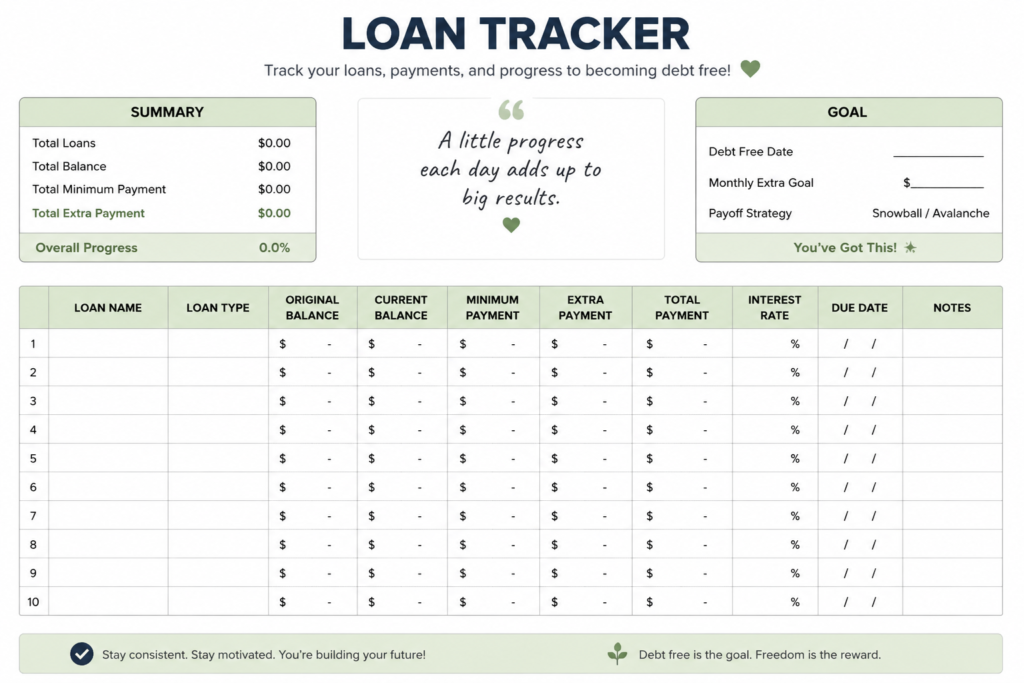
Before you can pick a strategy, you need a full, unemotional picture of what you owe. Pull your loan servicer statements (or log into studentaid.gov for federal loans) and list out, for every single loan:
- Loan type (federal subsidized/unsubsidized, Grad PLUS, or private)
- Current balance
- Interest rate
- Minimum monthly payment
- Loan servicer
Here’s what mine looks like right now, as an example of how to lay yours out:
| Loan | Balance | Interest Rate | Monthly Payment |
| Loan 1 | $21,099.79 | 6.21% | $401.26 |
| Loan 2 | $36,642.62 | 5.84% | $367.45 |
| Total | $57,742.41 | — | $768.71 |
Seeing it laid out this simply makes the next decision — which loan to attack first — much easier.
Once you can see everything in one place, patterns tend to jump out immediately. Usually one or two loans with a noticeably higher interest rate. These are the ones quietly costing you the most money over time.
Step 2: Choose Your Repayment Strategy — Snowball vs. Avalanche
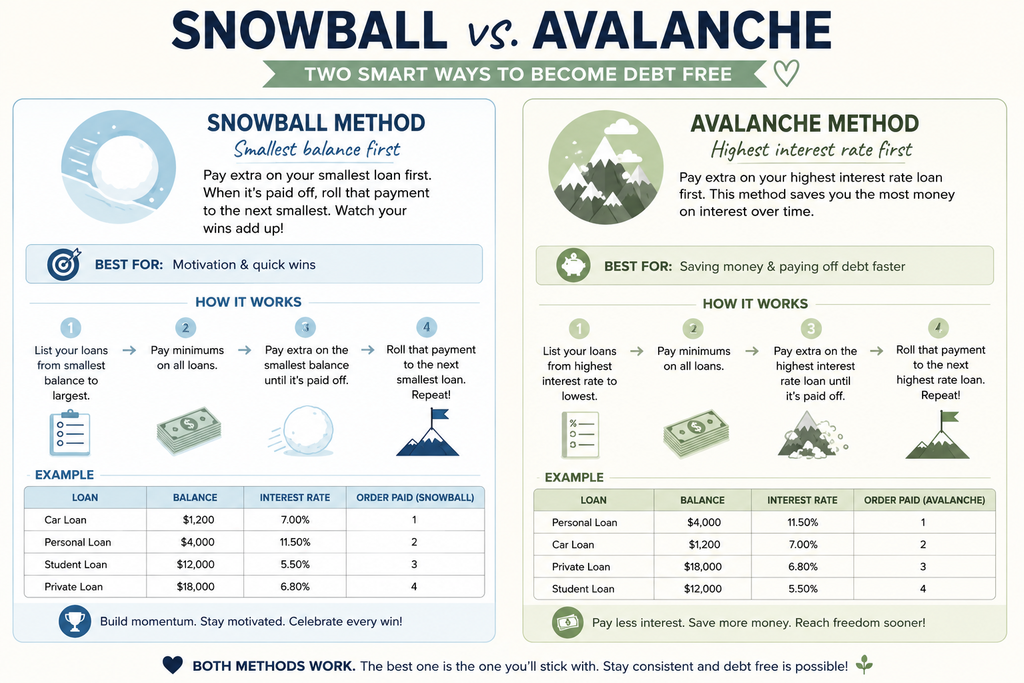
There are two classic approaches to paying off multiple loans. As a pharmacist, one of them usually makes more mathematical sense for you.
The snowball method: has you pay off your smallest balance first while making minimums on everything else. Then roll that payment into the next-smallest loan. It’s motivating because you get quick wins, but it isn’t optimized to save you the most money.
The avalanche method has you attack the loan with the highest interest rate first, regardless of balance size. Because pharmacists often have the income to make larger extra payments right out of the gate, the avalanche method typically saves more in interest over the life of the loan. For a debt load in the six figures, that difference can be thousands of dollars.
Using my own two loans as an example: my $21,099.79 balance happens to carry the higher rate (6.21%) and the smaller balance — so in my case, snowball and avalanche point to the exact same first move, which made the decision easy. That won’t always line up so neatly for you, so it’s worth running your own numbers rather than assuming. If I put an extra $300/month toward that 6.21% loan on top of the minimum. It clears out well ahead of schedule and frees up its full payment to throw at the second loan. This is exactly how the “snowball” effect kicks in even when you’re technically following the avalanche method.
If you know you need the psychological wins to stay consistent, the snowball method isn’t wrong — the best plan is the one you’ll actually stick to. But if you can commit to a spreadsheet over a feeling, avalanche will almost always get you out of debt faster as a pharmacist.
Step 3: Do You Qualify for Public Service Loan Forgiveness (PSLF)
This is the single biggest opportunity most new pharmacists overlook. I talk about constantly because so many pharmacists don’t realize they already qualify.
PSLF forgives your remaining federal Direct Loan balance after 120 qualifying monthly payments (10 years) while working full-time for a qualifying employer. Qualifying employers include:
- Government organizations (federal, state, local, tribal)
- 501(c)(3) nonprofit organizations
- Some other nonprofits providing qualifying public services
Here’s why this matters so much for pharmacists specifically: a huge number of hospitals — especially nonprofit and academic medical centers — qualify as PSLF-eligible employers. If you work as a hospital, health-system, VA, or academic medical center pharmacist, there’s a real chance your employer already checks the box.
To actually make PSLF work in your favor:
- Confirm your employer qualifies using the PSLF Help Tool on studentaid.gov
- Make sure you’re on a qualifying repayment plan (an income-driven repayment plan, not the standard 10-year plan)
- Submit the PSLF form annually to certify your employment and track your qualifying payment count
- Keep every confirmation and pay stub — servicer errors with payment counts are common
If you qualify, this can be dramatically faster and cheaper than paying your full balance off out of pocket — especially on a pharmacist’s federal loan balance, where the forgiven amount can be substantial.
I’ll admit this is the section I wish someone had sat me down and explained back in 2018. Between the low resident payments that didn’t even cover interest and the year-plus I spent not paying at all during COVID, PSLF is a path I could have been quietly building toward the entire time. If you’re earlier in your career than I was when I figured this out, don’t make the same mistake — check your employer’s eligibility today, not “someday.”

Step 4: Decide If Refinancing Makes Sense for You
Refinancing means replacing your existing loans with a new private loan, ideally at a lower interest rate. This can be a powerful move — but only in the right circumstances.
Refinancing can make sense if:
- You have only private loans (or federal loans you’re certain you won’t need forgiveness or income-driven protections on)
- You have strong credit and stable income (which most licensed, employed pharmacists do)
- You can secure a meaningfully lower rate than what you currently have
Refinancing is usually a mistake if:
- You have federal loans and any chance of pursuing PSLF or an income-driven forgiveness path, since refinancing federal loans into a private loan permanently forfeits those protections and forgiveness eligibility
- Your income situation is unstable (refinanced private loans don’t have the same hardship protections as federal loans)
If refinancing is the right move for your private loans, shop multiple lenders before committing — a lot of them let you check your rate with a soft credit pull first, so there’s no reason not to compare at least three offers side by side.

Step 5: Use Employer Assistance and Sign-On Incentives
This is another area where pharmacists have an advantage most professions don’t: many hospitals, health systems, and retail pharmacy chains offer student loan repayment assistance as a recruitment tool, especially in high-need areas or specialties.
Before you assume this isn’t available to you:
- Ask HR directly whether your employer offers a loan repayment assistance program (LRAP) — these are sometimes buried in benefits packets that new grads skip past
- Negotiate a sign-on bonus specifically earmarked for loan repayment if you’re taking a new position
- Look into state-based loan repayment programs for pharmacists who commit to working in underserved or rural areas
- If you’re doing a residency, ask whether the health system offers any post-residency retention bonus tied to loan repayment
Even a few thousand dollars a year from an employer program, applied directly to your highest-interest loan, can shave real time off your payoff plan.
Step 6: Build a Budget That Actually Accounts for a Pharmacist’s Income
This is the step most new pharmacists skip, and it’s the one that quietly sabotages the fastest payoff plans. You go from a resident or student stipend to a full pharmacist salary almost overnight, and it’s incredibly easy to let your spending rise right along with it — a nicer apartment, a new car, more takeout — before you’ve made a real dent in your loans.
A simple framework that works well on a pharmacist’s income:
- 50% needs — housing, utilities, insurance, minimum debt payments
- 30% wants — this is the category to be honest with yourself about
- 20%+ toward extra loan payments and savings — and if you’re serious about paying off debt fast, this is the number to push higher before your wants category grows
This is the step I’ll be honest about struggling with. When I got my first pharmacist paycheck in 2018 after years of student and resident wages, it was tempting to let spending rise with it — and later, during the COVID payment pause, I chose to redirect that freed-up money toward a house down payment instead of continuing to pay down debt I technically didn’t owe yet. That wasn’t a bad decision (a home is a real asset), but it’s worth naming honestly: every dollar diverted elsewhere is a dollar your future self has to catch back up on later. If I’d built a strict 50/30/20 split from day one and treated my “extra” loan payment like a non-negotiable bill, I likely would have knocked out both remaining loans by now instead of still working through them years later.
Automate your extra payments the same week your paycheck hits so the money never has a chance to feel “available” for discretionary spending. A simple app or spreadsheet is often enough — the goal isn’t a complicated system, it’s consistency.

Step 7: Protect Your Mental Health Along the Way
Six figures of debt sitting over your head, even with a solid plan, takes a psychological toll. Pharmacists are already working in a high-stress, high-stakes environment. It’s worth naming that directly instead of pretending the money side is the only side.
A few things that help:
- Set milestone celebrations, not just a single “debt-free” finish line years away
- Talk about it — with a partner, a friend in the profession, or a financial advisor who understands pharmacist-specific debt. You are far from alone in this; the vast majority of your colleagues are carrying something similar.
- Revisit your plan every few months rather than obsessing over it daily. A quarterly check-in keeps you accountable without letting the number consume you.
The Bottom Line
Pharmacist student loan debt is real, and for most new grads it’s substantial. Pharmacists have tools available that a lot of other borrowers don’t. They have a strong starting income, potential PSLF eligibility through hospital employment, employer repayment assistance, and refinancing options.
The fastest path out of debt isn’t about finding one magic trick — it’s about stacking the right combination of these strategies for your specific numbers, then staying consistent long enough for the plan to work.
Nine years after graduating with $180,000 in debt, I’ve paid that balance down to just over $57,700. I did this trough a residency salary, a full-court-press attack once I landed my first real job, and a COVID-era detour to save for a house. I’m not debt-free yet, but I’m proof that the combination of IBR, an aggressive payoff mindset when income allows for it. A little grace for the detours life throws at you can absolutely get you there. If I can claw back $122,000+ despite a slow start, a pandemic, and a few off-plan years, you can build a plan that gets you to zero even faster.
Disclaimer: This article is for educational purposes only and is not personalized financial or legal advice. Student loan servicers, forgiveness programs, and tax implications can change — always verify current details on studentaid.gov or with your loan servicer, and consult a financial advisor for guidance specific to your situation.