
//Affiliate Disclaimer: This post may contain affiliate links which mean I may receive a commission for purchases made through links. I will only recommend products that I personally love! Learn more on my Privacy Page.
Somewhere around your second week of pharmacology, you hit The Wall. You open a drug list, see fifty names that all sound like someone banged their head on a keyboard and just went with whatever letters came up, and your brain just… refuses. Metoprolol. Losartan. Ondansetron. Levetiracetam. It’s not that you’re bad at studying — it’s that most people try to memorize drug names the way they’d memorize a phone number, brute force, no hooks, no story. And brute force doesn’t stick.
The good news: pharmacology is actually one of the most memorizable subjects in healthcare education, because drug names aren’t random. They follow patterns. And once you attach a pattern, a joke, or a weird story to a name, it becomes almost impossible to forget — which is exactly the opposite of how it feels right now.
Here’s what actually worked for me through pharmacy school and a decade in emergency medicine and the ICU, where you don’t get the luxury of pausing to look something up mid-code.
Why Drug Names Are So Hard to Remember in the First Place
Two problems stack on top of each other. First, you’re learning two names for every drug — generic and brand — so you’re not memorizing one list, you’re memorizing two lists that have to map onto each other. Second, most drug names are built from Greek and Latin word roots that mean nothing to you yet, so your brain has no existing “hook” to hang them on.
The fix for both problems is the same: stop treating drug names as arbitrary strings of letters. Start treating them as characters in a story, with personalities, jobs, and inside jokes. Here’s how.
Method 1: Learn the Suffix, Not the Drug
This is the highest-yield trick in all of pharmacology, and most students discover it too late. Drug names within the same class almost always share a suffix, because generic names are standardized by international naming conventions. Once you know the suffix, you can often guess the class of a totally unfamiliar drug on sight.
A few of the big ones:
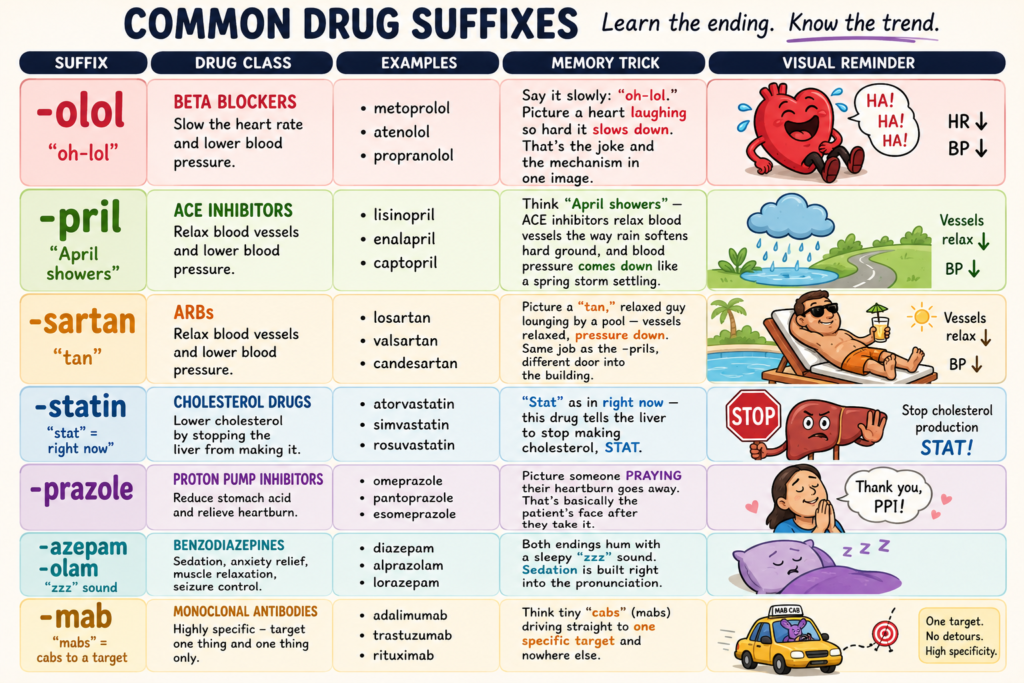
- -olol → beta blockers (metoprolol, atenolol, propranolol). Say it slowly: “oh-lol.” Picture a heart laughing so hard it slows down. That’s the joke and the mechanism in one image.
- -pril → ACE inhibitors (lisinopril, enalapril, captopril). Think “April showers” — ACE inhibitors relax blood vessels the way rain softens hard ground, and blood pressure comes down like a spring storm settling.
- -sartan → ARBs (losartan, valsartan). Picture a “tan,” relaxed guy lounging by a pool — vessels relaxed, pressure down, same job as the -prils, different door into the building.
- -statin → cholesterol drugs (atorvastatin, simvastatin). “Stat” as in right now — this drug tells the liver to stop making cholesterol, stat.
- -prazole → proton pump inhibitors (omeprazole, pantoprazole). Picture someone praying their heartburn goes away. That’s basically the patient’s face after they take it.
- -azepam / -olam → benzodiazepines (diazepam, alprazolam). Both endings hum with a sleepy “zzz” sound. Sedation, built right into the pronunciation.
- -mab → monoclonal antibodies (adalimumab, trastuzumab). Think of tiny “cabs” (mabs) driving straight to one specific target and nowhere else — that’s exactly how monoclonal antibodies work, high specificity, one destination.
Once suffixes click, you’re no longer memorizing 300 individual names. You’re memorizing about 20 patterns, and letting the pattern do the work for you.
Method 2: Give the Brand Name a Ridiculous Personality
Brand names are marketing, which means they were already built to be catchy — you just have to finish the job with your own twist. This is where funny wins, every time. Humor creates a stronger memory trace than a neutral fact does, because your brain tags emotionally charged information as important and files it differently.
A few examples that stuck with students I’ve mentored:
- Norvasc (amlodipine, a calcium channel blocker for blood pressure) → imagine a “Norse Vast” open field — wide open blood vessels, pressure flowing freely across the plains.
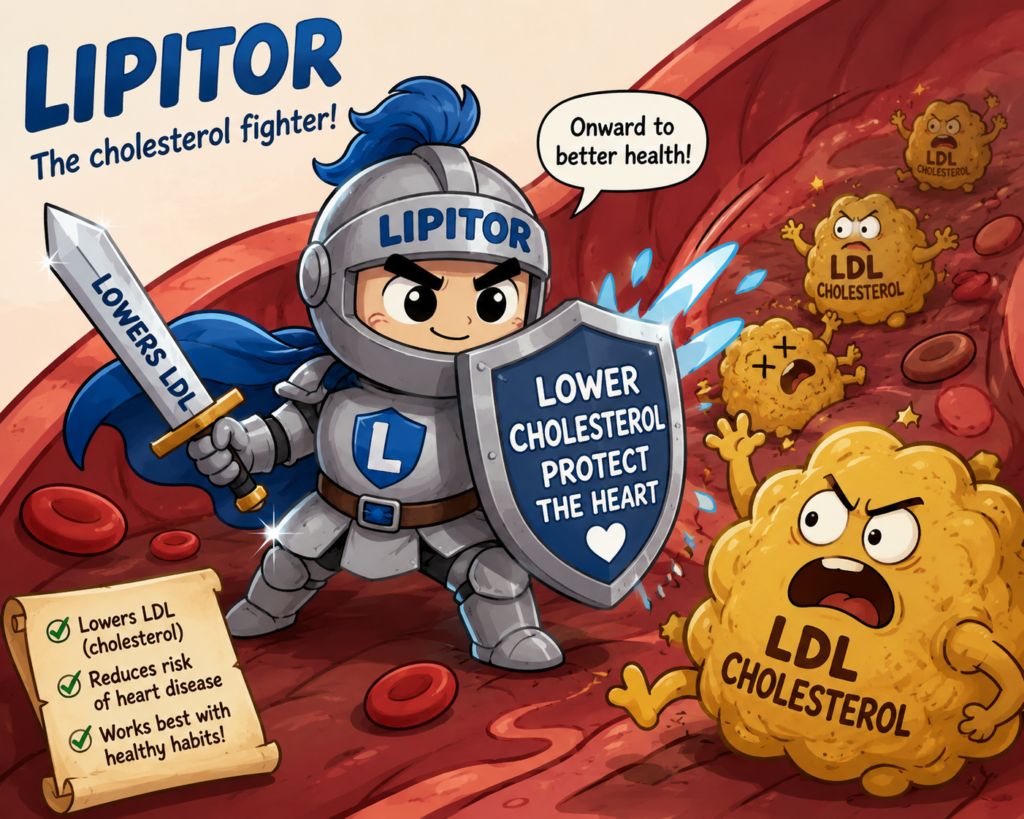
- Lipitor (atorvastatin) → “Lip-itor,” a knight who fights your bad cholesterol. He’s got a shield, he’s got a sword, he’s not letting LDL near your arteries.
- Xanax (alprazolam) → say it slow, “zzzan-ax.” An axe just… falls asleep mid-swing. Everything about this patient’s anxiety just goes limp.
- Coumadin (warfarin) → this one has a genuinely wild origin story worth knowing: warfarin started as rat poison. Picture a cartoon rat sliding on a blood-thinned floor. Once you know that story, you will never again forget that warfarin thins blood and carries a bleeding risk.
- Benadryl (diphenhydramine) → “Ben-a-dryl” — imagine Ben’s mouth going bone dry. Anticholinergic side effects (dry mouth, drowsiness) baked right into the name if you let it be.
The sillier the image, the better it works. Don’t hold back on the mental cartoon. Nobody’s grading your imagination.
Method 3: Isolate One Drug With One Patient Story
This is the single most powerful technique I used clinically, and it’s the one students underuse the most. Instead of trying to memorize a drug in the abstract, attach it to one specific patient — real or hypothetical — and one specific moment.
During one ICU rotation, I had a patient on amiodarone whose thyroid function went sideways a few weeks into therapy — a textbook, unforgettable reminder that amiodarone is loaded with iodine and can send thyroid labs in either direction. I have never once mixed up amiodarone’s side effect profile since, because I don’t remember a fact anymore. I remember that patient, that room, that moment the labs came back.
You don’t need real rotation experience to use this trick. Build the scenario yourself:
- Picture a specific patient (give them a name, an age, a reason they’re in front of you).
- Picture the drug being started, and one dramatic thing that happens because of it.
- Picture yourself explaining it to another provider in one sentence.
Your brain remembers stories far longer than it remembers lists, because stories have sequence, stakes, and a character to follow. A drug fact floating alone in space is forgettable. A drug fact attached to “the patient in bed 4” is not.

Method 4: Build Mnemonics for Anything With a List
Some drug facts are just inherently list-shaped — side effects, contraindications, monitoring parameters — and mnemonics are still the fastest way through them. A few classics, plus how to build your own:
- “SSRIs cause the 3 S’s”: Sexual dysfunction, Serotonin syndrome, Suicidality (early monitoring) — simple, alliterative, sticky.
- **Anticholinergic side effects — “Can’t see, can’t pee, can’t spit, can’t **“: dry eyes/blurred vision, urinary retention, dry mouth, constipation. Crude, memorable, never forgotten.
- Build your own with the first-letter method: take the list you’re struggling with, write the first letter of each item, and rearrange until it spells something absurd. The weirder the sentence, the more it sticks — “normal” sentences are boring and slide right out of memory.
Don’t just read someone else’s mnemonic once and move on. Build a few of your own. The act of constructing the mnemonic is itself a memory exercise, on top of whatever the mnemonic ends up encoding.
Method 5: Flashcards — Physical and Digital, Used Correctly
Flashcards work, but only if you use them with spaced repetition instead of cramming the same stack every day. Apps like Anki (free) use spaced repetition algorithms that show you a card right before you’re about to forget it, which is far more efficient than reviewing everything daily.
A structure that works well:
- Front: brand name only.
- Back: generic name, drug class, one-line mechanism, and your funny association or story.
- Physical index cards are genuinely still worth carrying for the drugs you keep missing — there’s something about the tactile shuffle-and-sort that digital cards don’t replicate for everyone. If you want to try a virtual version, I recommend AnkiDecks.
None of this sticks as well if you’re reviewing cards sprawled across your bed with the TV on in the background, either. If you haven’t set up a dedicated study space yet, it’s worth doing before you build your flashcard deck — check out How to Create the Ideal Study Space for a full walkthrough.

Method 6: Quiz a Classmate, Out Loud, Under Mild Pressure
Studying alone caps out at a certain point, because you can’t catch what you don’t know you don’t know. Pair up with a classmate and quiz each other out loud — not silently reading cards side by side, actually asking and answering. Explaining a drug’s mechanism to another person forces a level of retrieval that passive review never touches, and it exposes the gaps immediately. If you fumble explaining amiodarone’s mechanism to your study partner, you now know exactly what to fix before the exam does it for you.
A version of this that works even better: take turns teaching each drug class to each other like you’re presenting it for the first time. If you can’t explain it simply, you don’t know it yet — you’ve just recognized it.
Method 7: Group by Class, Not Alphabetically
If your syllabus or drug list is alphabetical, don’t study it that way. Rebuild it by class. Studying beta blockers, ARBs, and ACE inhibitors as one connected unit — same overall job (lower blood pressure), different mechanism — builds a mental filing cabinet where new drugs slot into existing folders instead of floating around loose. Isolated facts get lost. Categorized facts get filed.
Putting It All Together
None of these methods work in isolation nearly as well as they work stacked together. A realistic weekly rhythm looks like this: learn the suffix pattern for a new class, build one ridiculous brand-name association per drug, attach one drug in the class to a patient story, turn the side effects into a mnemonic, load it all into flashcards, and quiz a classmate on it before the week is out. That’s five separate memory hooks on the same piece of information — and information with five hooks is information that doesn’t come loose under exam pressure.
Drug names feel impossible right up until they don’t. The shift isn’t about studying harder. It’s about giving your brain something to actually hold onto — a joke, a face, a story, a rhythm — instead of a bare string of syllables it has no reason to keep.
What’s the drug name that’s giving you the hardest time right now? Drop it below — I’ll help you build a mnemonic for it.